Graduate Thesis Project
2024
Taandav: Learning Kuchipudi Online
A gamified e-learning platform that helps students master Kuchipudi, a traditional Indian dance form, through interactive tools, community and cultural storytelling.

Overview
Helping dancers learn Kuchipudi online
Taandav is a gamified e-learning platform designed to help students master Kuchipudi, a traditional Indian dance form. It focuses on the learning journey of students in the SAMPADA certificate program, adding interactive tools, community engagement, and cultural storytelling.
I designed it as my graduate thesis, from research through a functional MVP prototype, using Figma, Teachable Machine, HTML, CSS, JS and GitHub. I began by researching how cultural programs like SAMPADA support bicultural identity for second-generation immigrants, through literature reviews and case studies.
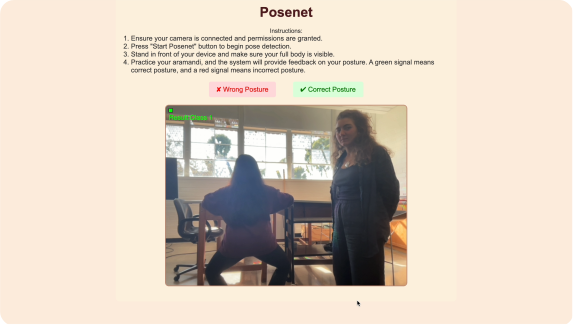
When 10 students tested the prototype at a dance school in Burbank, CA, 80% said they felt confident with Aramandi posture after using the pose-net feature.
Project trailer: https://www.youtube.com/watch?v=bf3aLvJRaZI&t=3s
Problem
Belonging between two cultures
Problem context
Second-generation immigrants in the U.S. often struggle to balance their cultural heritage with American identity, leading to challenges with self-esteem and belonging.
Potential solution
Leveraging traditional dance forms as an expressive and engaging medium to reconnect second-generation Indian-American youth with their heritage. Dance provides a unique way to foster cultural pride, build self-confidence, and strengthen community bonds, ultimately enabling the development of bicultural identity.

Dancer's Journey Context
A dancer's journey begins early, requiring about 10 years of training to master a solo recital. Lifelong learning continues through cultural organizations like Silicon Andhra, which provide opportunities to deepen engagement with the art form.
Cultural Organization: Silicon Andhra org in Bay Area, CA
Certification Program: 7 Different structured Indian Music & Dance certifications, NACC credited with over 1200+ students
Taandav Partnership: Working with affiliated dance teachers and their students in California
To understand my target audience, I surveyed 17+ dance students and found their main motivators were earning college credits, deepening their knowledge, and reconnecting with heritage. This feedback shaped Taandav’s key features.

“If I was in India, I don’t think I would have ever gotten back to learning dance. I am grateful there is an initiative like this in the US to learn dance!”Immigrant Professional reclaiming her love for dance thanks to SAMPADA
Challenge Statement
How might we help students overcome theory learning challenges, provide virtual guidance, and build a stronger sense of community in their SAMPADA journey?
Research
Listening to SAMPADA students
Research highlights
10 literature reviews: explored how cultural programs (e.g., Chinese schools) and bicultural identity positively impact immigrant youth
5 case studies: analyzed initiatives like SAMPADA and the Korean Traditional Dance Institute to understand community impact
Current learning journey
The student’s current learning journey relies heavily on self-study through physical books, PDFs, and pre-recorded videos, combined with in-person instruction and self-assessment, making asynchronous learning challenging and lacking real-time guidance or community support.


Pain points
Through surveys and interviews with 6 current and 25 past students, I identified three common pain points among those in the certification program, leveraging the SAMPADA dance community for insights.
Theory Learning Difficulties
Students find it difficult memorizing Sanskrit terms and understanding the complex, vague language of history content due to unclear objectives
No Virtual Guidance
Lack of external guidance for practicing and learning, with a need for more engaging, interactive content
Lack of Community
Absence of peer groups or study partners, leaving students feeling unsupported within the SAMPADA dance community

How might we help students overcome theory learning challenges, provide virtual guidance, and build a stronger sense of community in their SAMPADA journey?
Ideation
From challenge to flows
After initial ideation, a website was chosen as the optimal solution, considering time constraints, user testing plans, and access to the local dance community. This website solution is accessible for students across various locations and has the potential to be scalable beyond the SAMPADA program. It allows for interactive elements to make learning Kuchipudi more engaging!


User personas


User journey, user flows and wireframe testing


Designs
Taandav features


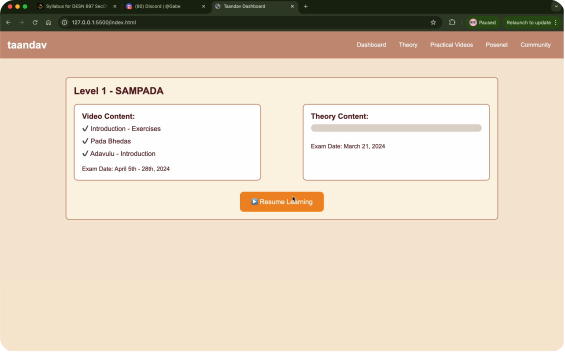
Building the prototype

Impact
Usability testing
User testing impact
I visited a local dance school in Burbank, CA, where 10 students tested my prototype, and I gathered valuable insights from their experience.
80% reported feeling confident with Aramandi posture after using the pose-net feature
70% rated the community feature a 5 (extremely useful) for their learning journey
70% reported a better understanding of dance vocabulary and theory content


